
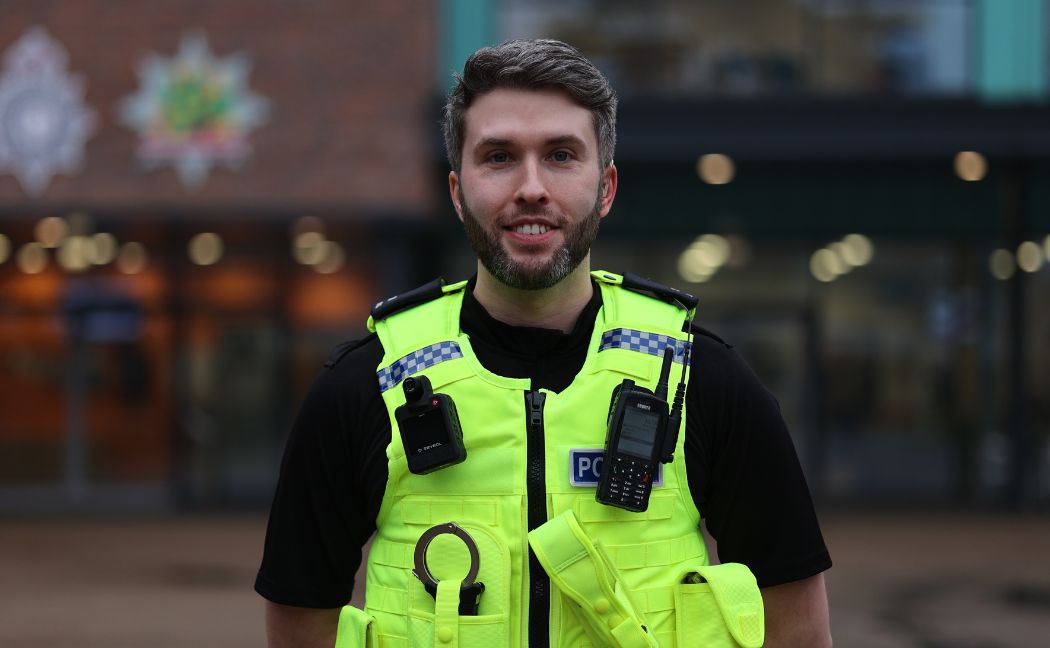
Meet PC Joe Jacks
What inspired you to become a police officer?
I suspect, like a lot of other police officers, my desire stemmed from an interest in policing. From a very young age, I saw the uniform and the blue lights and knew that it was something that I wanted to wear one day. As I’ve grown older and as the oldest on my cohort (something my colleagues remind me of regularly!), I’ve developed a strong moral compass and a genuine drive to help people who have been victims of crime and injustice.
I also come from a family of public service with both of my parents dedicating their entire careers to the NHS in Nottinghamshire, demonstrating to me a passion for supporting and helping others. Additionally, my grandparents both worked for Nottinghamshire Police; my grandmother as a member of police staff, and my grandfather as an inspector in the 80’s and 90’s across Newark and in the training school. His collar number, 1218 is one that I now wear with pride each day.
More recently, my partner of 10 years joined the force via the PCEP entry route. I was immensely inspired by his decision and seeing him grow in courage and ability, and the positive effect that it had on his life outside of work was the final spark that drove my decision to take the leap myself.
Why did you choose to start your policing career with Nottinghamshire Police?
My decision to join Nottinghamshire Police stems from wanting to serve the communities that I grew up in. Having spent my childhood in rural Nottinghamshire, and more recently having lived in an urban setting, I feel a strong sense of ‘home turf’ loyalty.
Beyond that, my decision was also influenced by my previous role in the charity sector. Having spent several years working for an organisation dedicated to supporting the elderly and the vulnerable, I found myself wanting to do more. After five years in the privileged position of working from home, I reached a point where I wanted to support the community in a face-to-face capacity. I felt a strong desire to be physically there for people in their greatest time of need and combined with my family heritage, Nottinghamshire Police felt like the natural place to begin my policing journey.
What made you choose the PCDA route into policing?
Since leaving higher education, I’ve continued to self-teach and expand my skillset. The PCDA entry route offered me the opportunity to think about the bigger picture regarding the causes and effects of crime on society, and how my decisions as a police officer will directly affect individuals and communities.
Having previously studied computer science, I was aware of the analytical thinking and skills taught by studying at a degree level and I was keen to study a subject that I knew would define my long-term career goals. Initially, I wasn’t sure if my previous studies would affect my eligibility to join policing through the PCDA route however, I discovered that Nottinghamshire Police values a diverse range of educational backgrounds and the PCDA route meant that I could develop my policing career with a deeper understanding of the theory, law and research that sits behind the uniform.
More practically, the PCDA route helped to ensure that I could make the jump into policing as somebody with a mortgage, bills and existing commitments. It allowed me to earn a full salary from day one whilst also working towards a degree. The opportunity to gain a university qualification without accruing any additional student debt was a massive benefit for me and gave me the best of both worlds. I can take what I have learnt in a lecture on a Monday and apply it to a real-life situation on the streets of Nottinghamshire on the Tuesday.
How are you finding the programme so far and what has been your favourite part?
Quite simply, I have loved every minute of the programme so far. From the pride of taking the oath at our attestation in front of family and friends, to stepping onto the parade square for inspection and receiving commendations from my sergeant, every day has felt like a step toward something bigger. Whether we’re in the classroom learning about complex laws and powers or being taught practical skills by the brilliant Nottinghamshire Police staff or University of Derby lecturers, I’m genuinely excited to get to work and dive into a new topic or skill.
There is no denying that the PCDA route is a significant commitment. It involves six months of intensive initial training followed by three years of studying alongside what will be a very demanding role. That said, for those who are motivated to be the best version of themselves, enjoy structured learning, and like the balance of academic learning with hands-on training, it is a fantastic entry route, and I truly believe it’s giving me the tools to be the best police officer I can be.
If I had to choose a favourite aspect, it would be the incredibly supportive environment I find myself in every single day. Every single person in my cohort is equally as excited to learn, and we really look out for one another. Whether that’s helping each other with statement writing, debating questions in class, or supporting each other with everything life throws at us outside of work, there is a real sense of camaraderie. This is also demonstrated by the teaching staff who go above and beyond to ensure our success.
How do you balance your academic studies with your training?
The training staff, university lecturers and sergeants at the training school all understand the level of work that is required from students on the PCDA programme. As the 15th cohort, it’s clear that feedback from those before us has been used to adapt the course. This has helped to create a structured programme that helps us balance the pressures of learning the law, studying for a degree and maintaining a work-life balance. We are given protected study days and self-study hours which are invaluable for catching up on statement writing, assignments, e-learning and interview preparation. These sessions provide us with the opportunity to stay on top of our workload and allow more time to unwind at home.
That said, some ownership must be taken by the individual. I dedicate time each evening on pre and post lesson reading to ensure I can actively engage in class discussions. I also chip away at my e-learning modules every week so that they don’t become an overwhelming task to complete before our official pass out parade.
A support network outside of work has also been incredibly helpful. My partner, who completed his own initial training just over a year ago knows exactly what the pressure is like and his support, particularly when deadlines are approaching, has allowed me to focus during the week so that I can truly switch off at the weekends. This also means I can enjoy the things that I love most, whether that’s long walks with our Cockerpoo, clay pigeon shooting or visiting family and friends.
If you could give one piece of advice to someone considering this career and joining through the PCDA route, what would it be?
My one piece of advice would be to just take the leap. I nearly joined the force back in 2019 via a different route but at the time, the timing didn’t feel right. Looking back, I’m so glad I waited as the PCDA route has been the perfect fit for where I am in life right now.
I definitely had my doubts initially. Applying at the age of 29, I was worried I might be too old to dive back into a degree or that I would struggle to balance the role with my home life. The reality is that it’s totally doable, and I haven’t had a single regret since starting. Even though I am only halfway through my initial training I have already gained a fantastic group of new friends and a wealth of practical skills and knowledge including emergency first aid, officer safety training , professional statement writing, interview techniques and knowledge of legal powers.
If you’re someone who is looking for a career with genuine purpose, don’t let the academic side or your age hold you back. If you are motivated, willing to learn and prepared to challenge yourself, the support is always there to help you succeed.